How to Read an Aeroplan Award Chart
If you have ever opened Aeroplan's award chart and immediately closed the tab, you are not alone. The chart looks like a spreadsheet built for an accountant, not a Vancouver traveller trying to figure out how many points a trip to Tokyo costs.
Here is the good news. Once you understand four core concepts, the entire chart becomes simple. This guide breaks it down in plain English, with real Vancouver examples, so you can read any Aeroplan award chart confidently going forward.
One important update before we start: Aeroplan published a new version of its award chart that takes effect June 1, 2026. We will note where pricing has changed so this guide reflects current reality, not outdated numbers.
Concept 1: The Four Travel Zones

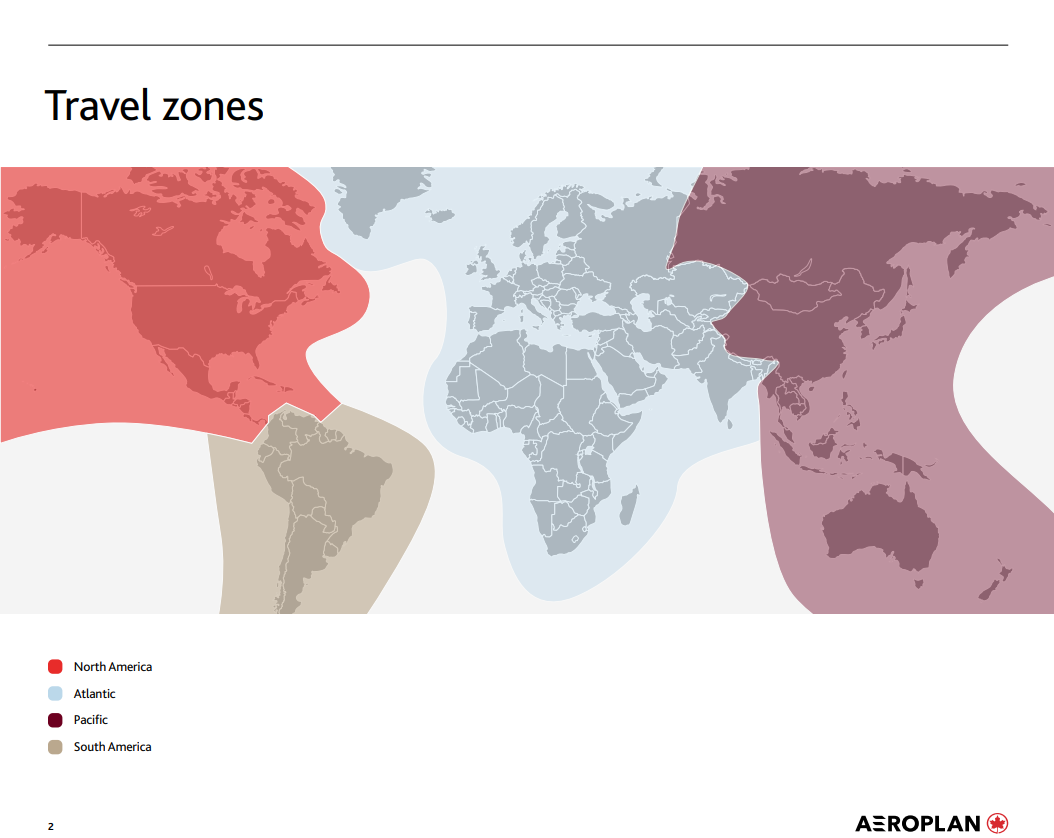
Aeroplan divides the entire world into four zones. Every award price is based on which zones your trip starts and ends in.
North America — Canada, the United States, Mexico, Central America, and the Caribbean
Atlantic — Europe, the Middle East, and Africa
Pacific — Asia, Australia, New Zealand, and the Pacific Islands
South America — All of South America
You can view the official four-zone map directly on Aeroplan's award chart page at https://www.aircanada.com/content/dam/aircanada/loyalty-content/documents/flight-rewards-chart-en.pdf
The zone combination determines which pricing table you look at. Flying from Vancouver, which sits in North America, to Tokyo, which sits in Pacific, means you reference the North America to Pacific chart. Flying from Vancouver to Frankfurt, in the Atlantic zone, means you reference the North America to Atlantic chart.
If your trip stays inside a single zone, for example Vancouver to Toronto, you reference the Within North America chart instead.
Concept 2: Distance Bands
Within each zone combination, pricing is further broken down by distance bands, measured in miles between your origin and destination.
The further you fly within the same zone combination, the more points it costs. This is why Vancouver to Tokyo costs differently than Toronto to Tokyo, even though both fall under North America to Pacific. Vancouver is closer to Asia, which puts it in a lower distance band.
To find the distance of any specific flight, use the Great Circle Mapper tool at gcmap.com, enter your origin and destination airport codes, and it calculates the exact mileage.
Once you have the distance, you find which band it falls into on the relevant zone chart, and that tells you your points cost.
Concept 3: Air Canada and Select Partners vs. All Other Partners
This is the single most important distinction in the entire chart and the one that confuses people most.
Aeroplan has two different types of pricing. The first is for flights on Air Canada and what it calls Select Partners, which includes United Airlines, Emirates, Flydubai, Etihad Airways, Canadian North, Calm Air, and Provincial Airlines. Instead of fixed pricing, awards on these carriers have a starting at price and sometimes a median price, but no published maximum.
In plain English: Air Canada and these specific partners use dynamic pricing. The number on the chart is just a floor. The actual price you see when booking can be significantly higher depending on demand, exactly like cash fares fluctuate.
All other Aeroplan partners have fixed award prices, available only when that partner makes seats available as partner awards. Self Made Millennials -
This means airlines like ANA, Lufthansa, Swiss, EVA Air, and the rest of Star Alliance's non-select partners have fixed pricing. The number on the chart is exactly what you pay, every time, regardless of demand.
This is why points experts consistently recommend booking partner airlines over Air Canada itself when possible. The price is locked, predictable, and often significantly lower than what Air Canada charges for the same route under dynamic pricing.
Concept 4: Starting At vs. Median
For the dynamic pricing carriers, the chart shows two numbers.
Starting at is the absolute floor, the best case scenario you might find on a quiet date with minimal demand.
Median amounts are based on member redemptions with Air Canada and select partners from January 2025 through December 2026, and are only displayed where available for flights either originating or ending in the North America zone.
The median is far more useful for realistic planning. It tells you what most people actually paid, not the theoretical best case that rarely shows up when you search.
Putting It Together: A Real YVR Example

Let us walk through pricing a real flight using these four concepts.
The trip: Vancouver to Tokyo, business class, on ANA
Step 1 — Identify the zones: Vancouver is North America. Tokyo is Pacific. We reference the North America to Pacific chart.
Step 2 — Identify the distance: Vancouver to Tokyo is approximately 4,710 miles, which falls within the shortest North America to Pacific distance band.
Step 3 — Identify the carrier type: ANA is not Air Canada or a Select Partner, so it falls under fixed pricing.
Step 4 — Read the fixed price: The fantastic sweet spot of Vancouver to Tokyo for 55,000 points in business class remains unchanged on the new June 2026 chart.
That is your answer. 55,000 Aeroplan points, fixed, every time you book this exact routing on ANA in business class, regardless of when you search.
Compare that to booking the same Vancouver to Tokyo route on Air Canada metal instead, which uses dynamic pricing and can price significantly higher depending on demand.
What Changed on June 1, 2026
If you have been reading older guides or comparing prices you remember from a few months ago, here is what is different now.
Aeroplan surgically devalued specific partner business class sweet spots, mostly Europe to Asia and US to deep Asia routings, while leaving most of the famous North America-originating sweet spots completely untouched.
The good news for Vancouver travellers specifically: the Vancouver to Tokyo sweet spot at 55,000 points in business class remains on the chart unchanged, and West coast flights like San Francisco to Taipei also remain the same at 75,000 points.
The bad news is concentrated elsewhere. Ultra long haul business class awards between North America and deep Asia, the 7,501 to 11,000 mile band, increased from 87,500 points to 102,500 points. This affects some longer Asia routings but the headline Vancouver to Tokyo sweet spot dodges this increase because it sits in a shorter distance band.
If most of your redemptions sit in the bottom half of Aeroplan's zone map, you can largely ignore this update. Within North America, between North America and South America, within South America, between Atlantic and South America, and between Pacific and South America all see zero changes across every distance band and cabin.
The official updated chart is published directly by Air Canada at https://www.aircanada.com/content/dam/aircanada/loyalty-content/documents/flight-rewards-chart-en.pdf
A Few More Things Worth Knowing
The stopover rule still applies. It is possible to make a stopover of more than 24 hours and less than 45 days on a one-way trip, at a fixed cost of 5,000 points regardless of which chart you are reading. This held through the June 2026 update with no changes.
There is a small partner booking fee. Air Canada charges a 39 CAD partner booking fee for awards that include a partner airline flight, but beyond this fee you only pay taxes, with no carrier-imposed fuel surcharges on partner awards.
You can route creatively. Up to six segments are allowed on a one-way award booking, which means complex multi-city itineraries are genuinely possible within the chart's rules, not just point to point trips.
The Bottom Line

Once you understand the four zones, distance bands, the dynamic versus fixed pricing split, and the difference between starting at and median pricing, reading any Aeroplan award chart becomes straightforward. The chart that looked intimidating five minutes ago is now something you can actually use to plan a real trip.
For Vancouver travelers specifically, the most important takeaway is this: always check whether a fixed-price partner airline operates your route before defaulting to Air Canada's dynamic pricing. The savings are often significant, and as the June 2026 update shows, Aeroplan's best North America-originating sweet spots have largely been protected even while other parts of the chart got more expensive.
If you want to know the moment a transfer bonus goes live, or when a specific Vancouver sweet spot opens up for booking, subscribe to YVRPoints below. We track the chart so you do not have to.
